Quick answer
There is no single best Battleship layout. In our simulation, ships laid flat along the edges cost a probability-based hunter about 6 extra shots (51.3 instead of 45.1), while fleets bunched in the center or packed into one touching group were found fastest. An opponent that learns your habits erases the edge advantage, so vary your layout.
There is no single best Battleship layout, but there are clearly bad ones. In our simulation, a fleet lying flat along the edges cost a probability-based hunter about 6 extra shots, while fleets bunched in the center or packed into one touching group were found fastest. An opponent who learns your habits erases any edge, so the best long-run plan is to vary where you hide.
I'm the developer of Torpedo, a sea battle game for iPhone and iPad, and when we built its computer opponent we needed hard numbers on where ships tend to be and which hiding styles hold up. We wrote a simulator, mapped 5 million random fleet layouts, and ran 400,000 games to test five placement styles against four different hunters. The raw results are public. For the shooting side of the game, see our Battleship strategy guide.
Where are ships most likely to be?
In the classic game (ships of 5, 4, 3, 3 and 2 squares), ships are most likely to cover the center of the board. Across 4 million random legal layouts, the square E5 held a ship 21.4% of the time, and its neighbors F5, E6 and F6 are statistically tied with it. The corners held a ship only 8.0% of the time. The board average is 17%, since the fleet covers 17 of 100 squares.
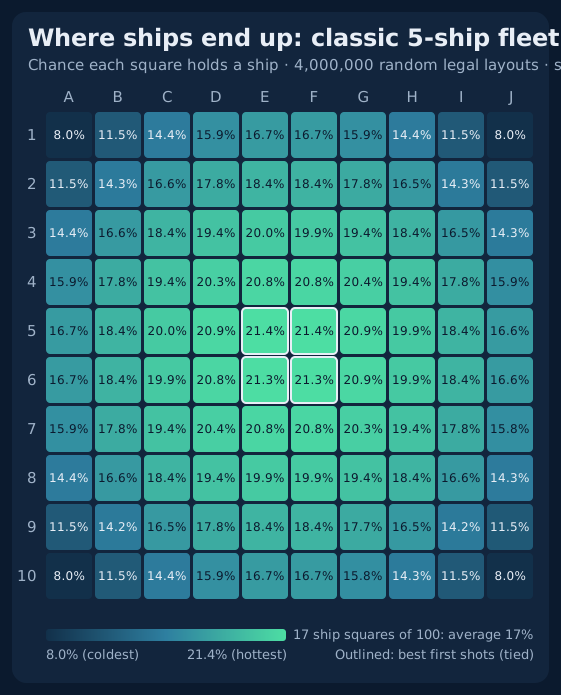
The reason is simple geometry: more positions pass through a central square. Count every way to place one ship of the classic fleet on an empty board and you get 760 placements. Of those, 34 cover E5 and only 10 cover the corner A1. For the five-square Carrier alone the gap is five to one (10 placements through E5, 2 through A1). Nick Berry described the same edge effect in his 2011 DataGenetics analysis: fewer placements reach the edges and corners.
The real map is milder than that count suggests. With all five ships placed together, the ships crowd each other, and the center-to-corner ratio drops from 3.4 on the empty-board count to 2.67 in actual layouts. A probability-based hunter starts from this map, which is why its first shots go to the middle.
Why does the 10-ship fleet flip the map toward the edges?
The 10-ship paper fleet (one ship of 4, two of 3, three of 2 and four of 1, with no touching even at corners) produces the opposite map. Across 1 million random legal layouts, edge squares are the most likely to hold a ship: C1, H1, A3, J3, A8, J8, C10 and H10 each about 25.7%. The ring one square in from the edge is the coldest (B9 at 14.7%), and the center sits at 18.2%.
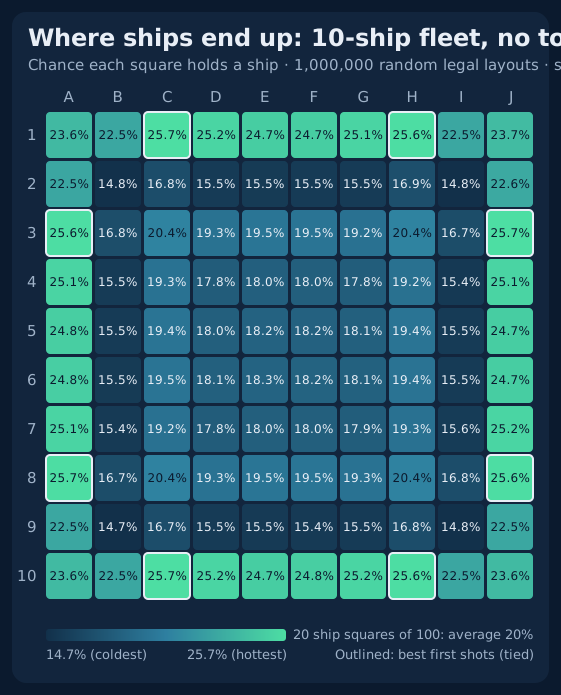
The no-touch rule causes the flip. Every ship needs a border of empty water around it. A ship on the edge has part of that border cut off by the edge of the board, so it uses up less of the sea and leaves more room for the other nine. Far more legal layouts put ships on the edge. The second ring is cold, most likely because a ship there blocks the edge row beside it without getting that discount.
This was the biggest surprise in our data. The simple count of single-ship placements on an empty board still points to the center (36 placements through a central square against 16 through a corner), so any method built on that count opens in the wrong place for this fleet. If you play the 10-ship game, a hunter who knows the real map will open on the edges, because that is where ships turn up most often. We ran the placement test below only for the classic fleet.
Which layout survives longest? The placement experiment
We tested five fleet styles for the classic fleet, 20,000 games for every style and hunter. Each fleet was drawn at random from all legal layouts that fit the style:
- Random: any legal layout, uniformly at random.
- Flat along the edges: every ship lies entirely on the outer ring of squares.
- Every ship touches the border: each ship has at least one square on the outer ring.
- Central 6×6: every ship inside the block C3 to H8.
- All ships touching: the five ships form one connected group.
The four hunters were a checkerboard hunt-and-target player, the textbook probability density method, Torpedo's Hard computer level, and Torpedo's Expert level after it had seen 20 earlier fleets of the same style. The table shows the average number of shots each hunter needed to sink the whole fleet. Higher is better for the hider.
| Fleet style | Checkerboard hunter | Probability density | Torpedo Hard | Torpedo Expert after 20 games |
|---|---|---|---|---|
| Random | 55.1 | 45.1 | 44.8 | 44.8 |
| Flat along the edges | 53.4 | 51.3 | 50.7 | 46.8 |
| Every ship touches the border | 55.1 | 49.5 | 49.0 | 47.4 |
| Central 6×6 | 48.9 | 42.5 | 42.5 | 36.3 |
| All ships touching | 47.2 | 43.3 | 43.7 | 42.2 |
What the placement results mean
- Edges beat probability hunters. A fleet flat along the edges took the probability hunter 6.2 shots longer to sink than a random fleet, and Torpedo Hard 5.9 longer. The share of games that hunter finished within 50 shots fell from 73.5% to 42.0%.
- Edges don't fool a checkerboard player. The same edge fleet was found slightly faster by the checkerboard hunter (53.4 shots instead of 55.1). A ship on the border has fewer neighbors, so after a hit there are fewer wrong squares left to probe.
- Touching the border is a weaker version. Ships that only touch the border with one end gained less, about 4 shots against the probability hunter (49.5).
- The center is the worst place to hide. A central 6×6 fleet lost faster than a random layout to every hunter, and Expert found it in 36.3 shots once it had learned the habit.
- Packing ships together backfires. One touching group was found in 43.3 shots by the probability hunter and 47.2 by the checkerboard hunter. Only 0.98% of random layouts form one connected group, so this is a deliberate choice, and a poor one.
Does the best layout depend on your opponent?
Yes, and that is why no single layout wins. Against a computer, or a friend, who opens in the middle and plays the odds, an edge fleet buys you about 6 shots, which is a big edge in a game decided by who finishes first. Against someone who sweeps the board in a plain checkerboard, edges give you nothing and cost a shot or two.
We didn't measure real people, so treat this as a guide rather than a law: the checkerboard hunter stands in for a methodical player, and the probability hunter for one who aims where ships are most likely. Most players fall somewhere between the two.
The meta-game: what if your opponent has read this too?
If your friend reads this article, your edge fleet becomes a liability. They will shoot the edges first, and you lose the 6 shots and probably more. That is exactly what Torpedo's Expert level does: after 20 games against a player who always hugs the edges, it sank the fleet in 46.8 shots instead of the 50.7 that Hard needs.
The defense is to keep your opponent guessing:
- Rotate between styles. Use edge layouts often against a strong opponent, but not every game.
- Mix in fully random layouts. A random fleet costs every hunter about the same and gives them no pattern to learn.
- Never hide in the middle cluster or one big group. Those were the only styles that lost to every hunter.
- Watch your own habits. If your Destroyer always ends up in the same corner, a good opponent will notice.
How does a Battleship AI decide where to shoot?
The strongest hunting method in our tests is probability density, which Berry described in 2011. In plain words:
- For each enemy ship still afloat, list every position it could occupy without crossing a known miss or a sunk ship.
- For each square, count how many of those positions cover it.
- Fire at the square with the highest count.
- After a hit, count only positions that pass through the hit, so the next shots follow the wounded ship.
- Repeat after every shot, since each answer rules positions out.
This method sank the classic fleet in 45.0 shots on average in our simulation, against 95.4 for random fire. It also explains why edge fleets work against it: its count favors the center, so it searches there first.
Torpedo's Hard level works this way. While a ship is wounded, it counts positions through the hits and weights them by the square of how many hits they cover, and it picks its first eight search shots at random among the five best squares, so its opening doesn't repeat. It averaged 44.9 shots. Expert drops the random opening and adds a memory: after each game it records where your ships were, and while searching it multiplies each square's count by up to 1.6 for squares you use often. Neither level sees your board during a game. Expert learns from your fleet only after the game ends, which is how a person would remember your style.
Both levels count positions ship by ship, which points to the center on an empty board. As the 10-ship map shows, the edges would be a better place to open against the no-touch fleet.
Is Torpedo's Shuffle button a random layout?
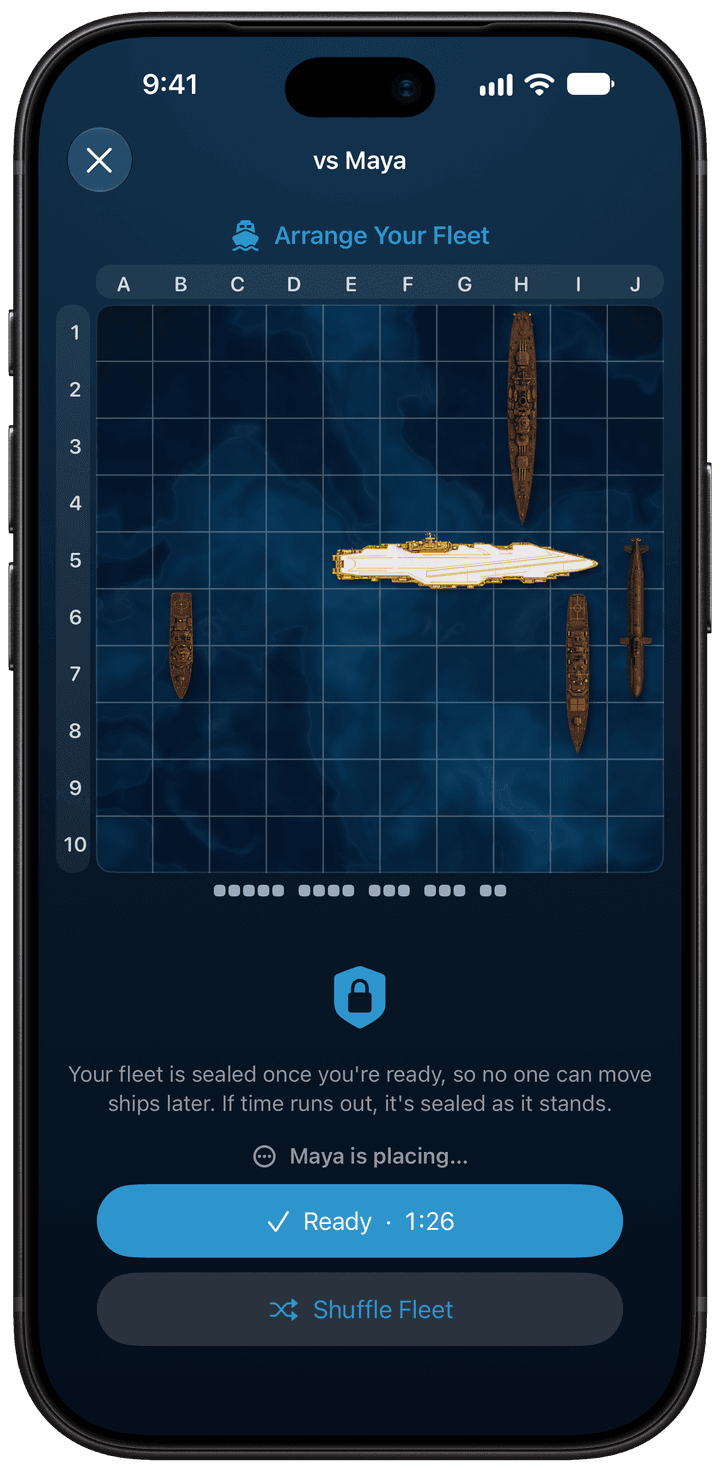
Not exactly, and we'd rather say so. Torpedo's automatic placement, used for the computer's fleet and the Shuffle button, places ships one at a time, largest first. That makes it a little more center-heavy than a truly random pick in the classic game (center squares hold a ship 22.2% of the time instead of 21.4%) and almost flat for the 10-ship fleet instead of edge-heavy. The computer's results barely change. If you want the edge effect from this guide, place your ships by hand.
For the rules behind both fleets, see our guide to Battleship rules. To try layouts with a friend and a pencil, our paper Battleship guide has a printable grid, and Torpedo's features page lists the computer levels and modes.
Questions people ask
What is the best placement in Battleship?
No layout is best every game. Against an opponent who aims at the likeliest squares, ships lying flat along the edges survived longest in our simulation, costing that hunter about 6 extra shots. Against a plain checkerboard search the same layout was found slightly faster, so the safest habit is to vary your layout.
Is it better to put your ships on the edge in Battleship?
Against a probability-based hunter, yes: an edge fleet took it 51.3 shots to sink instead of 45.1. Against a checkerboard hunter, no: it found edge fleets in 53.4 shots instead of 55.1. An opponent who learns that you hug the edges cancels most of the gain.
Should your ships touch in Battleship?
Packing every ship into one touching group is a poor idea. In our test it was found in 43.3 shots by a probability hunter and 47.2 by a checkerboard hunter, both faster than a random layout, because one hit leads straight to the next ship.
Which squares are most likely to hold a ship in Battleship?
With the classic five-ship fleet, the four center squares E5, F5, E6 and F6: each holds a ship about 21.4% of the time, against 8.0% for a corner. With the 10-ship fleet and no touching, the pattern flips and edge squares such as C1 and A3 are hottest at about 25.7%.
How does a Battleship AI decide where to shoot?
The strongest programs count, for every square, how many ways the remaining ships could still fit through it, then fire at the square with the highest count. After a hit they count only positions through that hit. This probability density method sank the classic fleet in 45.0 shots on average in our simulation.
Hide your fleet. Find theirs.

Sources
- Battleship, DataGenetics (Nick Berry, 2011), datagenetics.com
- Sea battle simulation results, October 2026 (raw data, seed 20261007), Appalex Kft., playtorpedo.com
Battleship is a trademark of Hasbro. Torpedo is an independent game and is not affiliated with or endorsed by Hasbro.
