Quick answer
The best Battleship strategy is to search on a checkerboard, switch to the squares around a hit as soon as you score one, and aim where the most ships can still fit. In 100,000 simulated games per method, random fire needed 95.4 shots to sink the classic fleet, hunt and target 62.1, adding a checkerboard 55.1, and probability hunting 45.0.
To win at Battleship, stop firing at random. Search on a checkerboard, switch to the squares around a hit the moment you score one, and aim at the squares where the most enemy ships could still fit. In our simulation of 100,000 games per method, random fire needed about 95 shots to sink the classic fleet, hunt and target about 62, a checkerboard search about 55, and probability hunting about 45.
When we built the computer opponent for Torpedo, our sea battle game for iPhone and iPad, we needed to know exactly how much each of these ideas is worth. So we wrote a simulator, ported Torpedo's five computer levels into it line by line, checked the port against the real Swift code, and played 1.75 million games. Every number in this guide comes from that run, and the raw results are public. (Want to practise against a fair computer? Our comparison of sea battle apps ranks eight of them.)
What did our simulation find?
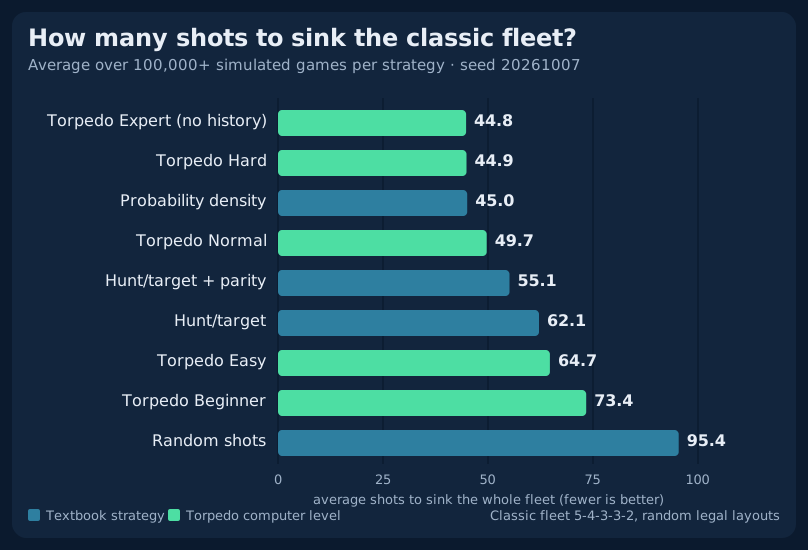
Each strategy below played 100,000 games against the classic fleet (ships of 5, 4, 3, 3 and 2 squares, 17 in all), with fleets drawn uniformly at random from every legal layout. We counted how many shots it took to sink the whole fleet. Fewer is better.
| Strategy | Average shots | Median | Fleet sunk within 50 shots |
|---|---|---|---|
| Random shots | 95.4 | 97 | 0.0% |
| Hunt and target | 62.1 | 62 | 22.1% |
| Hunt and target + checkerboard | 55.1 | 56 | 28.6% |
| Probability density | 45.0 | 44 | 73.6% |
The first step is the biggest by far: reacting to your hits saves 33 shots. The checkerboard adds 7, and thinking in probabilities adds another 10. A probability hunter finishes almost three games in four within 50 shots, while random fire never did once in 100,000 tries.
How does this compare with the DataGenetics study?
The best-known analysis of the game is Nick Berry's 2011 post on DataGenetics, which ran 100 million games per algorithm. He reported a median of 97 shots for random fire, 64 for hunt and target with parity, and 42 for probability density.
Our random result matches his exactly (median 97). Our checkerboard hunter does better (median 56) because it is told which squares a sunk ship occupied, the way Torpedo shows every wreck; Berry's version didn't know when a ship had sunk and kept probing around every hit. Our probability hunter is two shots slower at the median (44). It counts placements ship by ship rather than whole-fleet layouts, and small implementation choices like that move the result by a shot or two.
1. Why should you never fire at random?
Firing at random is the slowest way to play: 95.4 shots on average, a median of 97, and not one game in 100,000 finished within 50 shots. The fleet covers only 17 of the 100 squares, so your first shot hits just 17% of the time, and blind fire keeps ignoring what earlier shots revealed.
The deeper problem is the end of the game. The last ship square is usually one of the last squares you try, because nothing steers you toward it. Every strategy below fixes that the same way: each shot uses what the previous shots told you.
2. How does hunt and target work?
Hunt and target splits your shots into two modes, and switching between them is worth more than any other habit in the game.
- Hunt. Fire around the board looking for a first hit.
- Target. After a hit, fire at the four squares next to it (up, down, left, right) until you find the next hit.
- Follow the line. Two hits in a row tell you which way the ship runs. Keep firing along that line.
- Go back to hunting once the ship sinks.
In our simulation, this simple switch cut the average from 95.4 shots to 62.1, and 22.1% of games ended within 50 shots. The remaining gains all come from hunting smarter.
3. Does the checkerboard (parity) strategy work?
Yes, in the classic game it saves about 7 shots. The smallest ship covers two squares, so every ship must cover at least one square of a checkerboard. You only need to search the 50 shaded squares to find every ship, which halves the hunt. Berry's DataGenetics post calls this parity.
With parity, hunt and target dropped from 62.1 to 55.1 shots on average. The worst case improved even more: the slowest parity game took 74 shots, while plain hunt and target sometimes needed all 100.
How do you adjust the spacing?
Match the spacing to the smallest ship still afloat. While the Destroyer (2) is alive, search every second square. Once it sinks, the smallest ship is three long, so every third square along each diagonal will do, as in the right-hand board. A related trick: skip any gap between misses that is too short to hold the smallest ship left.
Torpedo's Normal level does both. It spaces its search to the smallest ship afloat, skips gaps that can't hide one, and extends a line of hits from both ends. Together those refinements bring it to 49.7 shots, about 5 better than the plain checkerboard hunter.
Why does the checkerboard stop working with the 10-ship fleet?
The 10-ship paper fleet (one 4, two 3s, three 2s and four 1s, no touching) includes single-square ships, and a checkerboard can miss those completely. In our 50,000 games with that fleet, parity improved hunt and target only from 63.2 to 63.0 shots. Until the last single-square ship is gone, every square is a possible hiding place.
4. Where should you aim? Think in probabilities
The strongest method counts possibilities. For each ship still afloat, count every position it could occupy given your hits and misses so far, add those counts up for each square, and fire at the square with the highest total. This is the probability density method that Berry popularized, and it was the best reference strategy we tested: 45.0 shots on average, 73.6% of games finished within 50 shots.
On an empty board the center wins. There are 760 ways to place a single ship of the classic fleet, and 34 of them cover E5, against 10 for the corner square A1. With all five ships placed together, across 4 million random legal layouts, E5 held a ship 21.4% of the time and the corners 8.0%. The best first shots are E5, F5, E6 and F6, which are statistically tied.
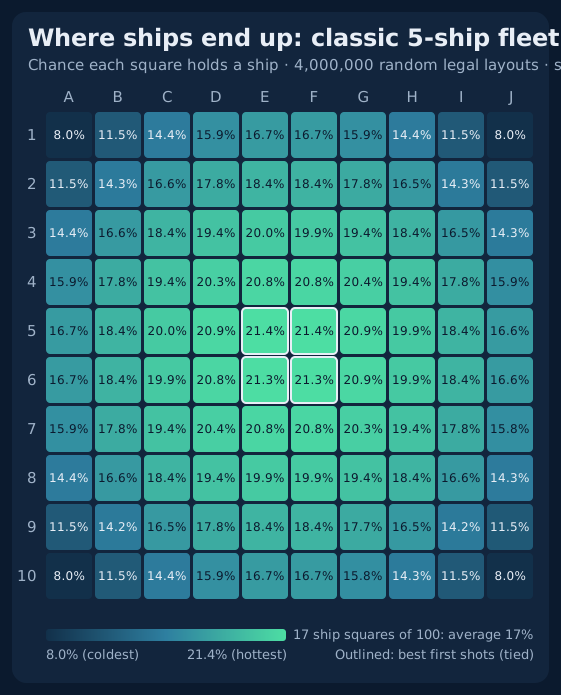
You can't count 760 placements in your head every turn, but you can follow the same logic:
- Prefer squares with long open runs both across and down. A ship of 5 needs five open squares in a line.
- Avoid squares hemmed in by misses. If a pocket is too small for any ship still afloat, it is empty.
- Expect ships away from the corners early in the game, then widen out as the center fills with misses.
5. After a hit, how do you find the rest of the ship?
Work the line, then check both ends. Once two hits sit side by side, fire along that line. When it ends in a miss, go back to the other end of the line instead of probing sideways. A good hunter rarely fires at a square beside a line of hits, because a straight ship can't bend.
Be ready for the hit that isn't the ship you think it is. In the classic game ships may touch, so a row of hits can belong to two ships lying end to end or side by side. Two clues give it away:
- Too many hits for one ship. If you have five hits in a row and nothing has sunk, at least two ships are involved, because the Carrier would have sunk on its fifth hit.
- A sinking that leaves hits over. If a ship sinks and some of your hits aren't part of it, a second ship is right there (see the next strategy).
The probability hunter handles this automatically: while a hit is unresolved, it counts only placements through that hit and prefers placements that explain several hits at once. That smarter targeting is part of the 10-shot gap between the checkerboard hunter and the probability hunter.
6. What does "you sank my ship" tell you?
A sinking is the most informative answer in the game. Use it three ways.
- Remove that ship from your count. If the Destroyer is gone, no two-square gap can hide anything any more, and your search spacing widens (strategy 3).
- Account for every hit. Hits that don't belong to the sunk ship mark another ship that is still afloat.
- Clear the water around it when ships may not touch. In the 10-ship game the squares around a wreck must be empty, so mark them and never fire there. Torpedo reveals that water automatically.
Our simulation tells each strategy where a sunk ship lay, because Torpedo shows every wreck. On paper you usually hear only the ship's name, so you have to work out its squares as in the diagram above.
7. How should you hide your own fleet?
Placement matters less than shooting, but it still moved our results by up to 9 shots. We tested five fleet styles in 20,000 games each against four hunters. The short version:
- Ships flat along the edges cost a probability hunter about 6 extra shots (51.3 instead of 45.1), because it starts in the center.
- The same edge fleet was found faster by a checkerboard hunter (53.4 shots instead of 55.1).
- Bunching ships in the middle was the worst choice against every hunter, and packing all five into one touching group backfired too.
- A learning opponent erases your edge. After 20 games against an edge-hugger, a hunter that remembers your habits needed only 46.8 shots.
So vary your layout from game to game. The full heatmaps, the placement table and the reasons behind each result are in our guide to the best Battleship layout.
How do house rules change the strategy?
The math above assumes the classic fleet and one shot at a time. Three common variants shift it.
A hit earns another shot. Many players, and many European paper traditions, let you keep firing until you miss. That doesn't change how many shots you need to sink a fleet, so all the averages above still hold. It changes how often you get to fire them: every hit keeps the turn, so finishing a wounded ship quickly matters even more.
Salvo. In Salvo you fire several shots per turn, one for each of your ships still afloat, and hear the results together. We didn't simulate Salvo, so take this as reasoning rather than measurement: shots in one volley can't react to each other, so spread them over your checkerboard instead of bunching them, and use the next volley to follow up any hits. Losing ships shrinks your volleys, so sinking enemy ships early also takes shots away from your opponent.
The 10-ship fleet with no touching. Single-square ships make the checkerboard nearly useless (strategy 3), but every sinking reveals the empty water around the wreck. The heatmap also flips: with this fleet the edge squares are the most likely to hold a ship, about 25.7% for squares such as C1, H1, A3 and J3, against 18.2% in the center. Open on the edges, not in the middle. Our rules guide covers both fleets, and Torpedo's rules page lists the variants you can switch on.
Practice against Torpedo's computer levels
Torpedo's five computer levels map neatly onto the strategies above, which makes them a good training ladder. We ran each level 100,000 times against the classic fleet and 50,000 times against the 10-ship fleet. None of them sees your board; they aim only from hits, misses and sunk ships, like you.
| Level | How it aims | Classic fleet, average shots | Classic, sunk within 50 shots | 10-ship fleet, average shots |
|---|---|---|---|---|
| Beginner | Mostly random; follows up a hit 3 times in 10 | 73.4 | 1.3% | 67.1 |
| Easy | Mostly random; follows up a hit 6 times in 10 | 64.7 | 14.5% | 64.2 |
| Normal | Hunt and target, spacing matched to the smallest ship | 49.7 | 51.7% | 59.3 |
| Hard | Probability density, randomized first 8 search shots | 44.9 | 74.4% | 57.5 |
| Expert | Probability density plus a memory of where you hide | 44.8 | 74.5% | 57.6 |
To check that these figures describe the real app, we compiled Torpedo's own targeting code into a test harness and played 5,000 games per level against the Python port. All ten level and fleet pairs agreed within 1.4 standard errors.
A sensible order: beat Normal with a clean checkerboard and good targeting, then move to Hard, which plays at the level of the textbook probability method. To beat Hard more often than not, you have to sink its fleet in fewer shots than the 44.9 it needs on average for yours.
Expert has one more trick. After each game it records where your ships were, and while searching it boosts the squares you tend to use. In our placement test, a player who always clustered the fleet in the central 6×6 was found in 36.3 shots by Expert after 20 games, against 42.5 by Hard. Varying your layout is the counter.
If you'd rather practice with a friend at the kitchen table, our guide to playing Battleship on paper has a printable grid, and the history of the sea battle game explains where the 10-ship fleet comes from.
Questions people ask
Is there a strategy to Battleship, or is it just luck?
There is real strategy. In our simulation, firing at random needed 95.4 shots on average to sink the classic fleet, while a probability-based hunter needed 45.0, less than half. Luck still decides close games: even the best method ranged from 34 to 58 shots in the middle 80% of games.
Where is the best first shot in Battleship?
One of the four center squares, E5, F5, E6 or F6. Across 4 million random legal layouts of the classic fleet, E5 held a ship 21.4% of the time, against 8.0% for a corner. In the 10-ship game with no touching, edge squares such as C1 or A3 are better at about 25.7%.
What is the fewest shots you can win Battleship in?
Seventeen, one for each square of the classic five-ship fleet, and only if every shot hits. The fastest game our probability hunter played in 100,000 tries took 19 shots; its average was 45.0.
What is the hunt and target strategy in Battleship?
Hunt and target splits your shots into two modes. While hunting, you search the board for a first hit; after a hit, you target the squares around it until the ship sinks, then go back to hunting. In our simulation it cut the average from 95.4 shots to 62.1.
Can you beat a computer at Battleship?
Yes, because luck decides a lot. Torpedo's Hard level averaged 44.9 shots on the classic fleet, but its games ranged from 33 to 58 shots in the middle 80%, so a player who aims by probability and targets cleanly wins plenty of them. Beating it consistently takes play at its own level.
Put the math to work

Sources
- Battleship, DataGenetics (Nick Berry, 2011), datagenetics.com
- Sea battle simulation results, October 2026 (raw data, seed 20261007), Appalex Kft., playtorpedo.com
- Battleship (game), Wikipedia, en.wikipedia.org
Battleship is a trademark of Hasbro. Torpedo is an independent game and is not affiliated with or endorsed by Hasbro.
