Quick answer
No one knows who invented the sea battle game. It started as a pencil-and-paper folk game, and the earliest dated mention is a Russian diary entry from 1907. The first known commercial edition was Salvo in 1931, Milton Bradley sold a paper pad version in 1943, and its plastic Battleship board game arrived in 1967.
Nobody knows who invented Battleship. The sea battle game began as a pencil-and-paper folk game with no documented inventor, and the earliest dated mention I could find is a Russian poet's diary entry from December 1907. The first known commercial edition was Salvo in 1931, and Milton Bradley's plastic Battleship board game followed in 1967.
I make a sea battle game for iPhone, so I went looking for dates I could check, not the origin stories copied from site to site. Most of those stories fall apart once you read the sources.
When was Battleship invented? A dated timeline
The game was never invented in a single year. It grew on paper, then publishers printed it on pads, then Milton Bradley turned it into a plastic board game. Each row below links to the source for that date.
| Year | What happened | Source |
|---|---|---|
| 1890 | E. I. Horsman copyrights Basilinda, a war game played with pegs behind a cardboard screen. Often named as a forerunner, but it has no grid guessing. | The Strong |
| 1907 | Poet Ryurik Ivnev writes in his diary that he played "морской бой" (sea battle) with a friend. | Prozhito |
| 1931 | Starex Novelty Co. of New York sells Salvo, the first known commercial edition, with printed grid pads. | The Strong |
| 1932–1942 | More pad games appear: Wings (1932), Combat, The Battleship Game (1933), Admirals (1939), Warfare Naval Combat (1940s), Combat (1942). | The Big Game Hunter |
| 1943 | Milton Bradley publishes Broadsides: The Game of Naval Strategy, a pencil-and-paper pad game. | The Strong |
| 1967 | Milton Bradley releases the plastic Battleship. Its trademark records first use in commerce on February 27, 1967. | Justia (USPTO data) |
| 1973–1975 | 101 BASIC Computer Games prints the game as two BASIC programs, SALVO and BATTLE. | Internet Archive |
| 1977 | Milton Bradley releases Electronic Battleship. | The Strong |
| 1978 | Jim Butterfield's Battleships runs on the Commodore PET. | MobyGames |
| 1984 | Hasbro acquires Milton Bradley. | Hasbro 10-K, SEC |
| 1989 | Electronic Talking Battleship adds speech and solo play. | BoardGameGeek |
| 1993 | Console versions for the NES and Game Gear. | Wikipedia |
| 2002 | Hasbro renames two ships; the sizes stay 5, 4, 3, 3, 2. | 2002 rulebook |
| 2011 | DataGenetics publishes its analysis of shooting strategies. | DataGenetics |
| 2012 | Universal Pictures releases the film Battleship, loosely based on the game. | The Strong |
| 2025 | The game enters the National Toy Hall of Fame on November 6. | The Strong |
Who invented Battleship?
No one can be named as the inventor of the sea battle game. As a BoardGameGeek contributor points out, pen-and-paper games played by kids at school "rarely have a traceable inventor," and the earliest commercial editions packaged a game people already played. Four origin stories still circulate, and none of them survives a check of the sources.
The Russian officers story
The Strong museum writes that "during World War I, Russian officers reportedly played a similar game on a hand-drawn paper grid" (The Strong). Wikipedia says before the war and traces the claim to a 1931 Milwaukee Journal article published for Salvo's launch, which makes it launch publicity (Wikipedia). A collector's history dates the same story to 1917–1922 (The Big Game Hunter). That is three dates for one anecdote with no first-hand account behind any of them, so I treat it as an unverified story.
Clifford Von Wickler
Some sites say a Clifford Von Wickler invented the game around 1900 and never patented it. There is no primary evidence for that. Even the BoardGameGeek page that repeats the name carries a rebuttal: no man of that name "is ever mentioned outside the context of Battleship" (BoardGameGeek).
L'Attaque and Basilinda
Another claim is that the game came from the French L'Attaque, repeated by Military Times. But Hermance Edan's 1908 patent describes a "battle game with mobile pieces on a gameboard," the ancestor of Stratego, not a grid-guessing game (Wikipedia). Edan did file a French patent titled Jeu de "bataille navale" in 1913, but only its title and dates are online, so its rules are unknown (Google Patents). Basilinda (1890) shares the hidden-army idea and nothing more.
"Milton Bradley invented it in 1931"
Several Wikipedia language editions repeat this. The 1931 game was Starex's Salvo. Milton Bradley's first version was the 1943 pad game Broadsides (The Strong).
Where did the pencil-and-paper game come from?
The oldest dated trace of the sea battle game is a diary entry. On December 1, 1907 (November 18 in the old Russian calendar), the poet Ryurik Ivnev wrote: "Мы провели время весело: играли в морской бой, болтали." In English: "We had a good time: played sea battle, chatted" (Prozhito diary corpus).
The entry proves the name was in casual use in Russia before World War I. It does not describe the rules, so we can't prove Ivnev played on a grid. Still, it predates the first known commercial edition by 24 years, and "sea battle" is the name the game still carries in Russian today.
The paper game needs only squared paper and a pencil, and you can still play it that way: our guide to playing on paper has a printable sheet.
What was Battleship originally called? The 1930s and 1940s pad games
Before the plastic board, the game was sold as pads of printed grids. Salvo (Starex Novelty Co., 1931) is the first known edition, and The Strong holds a 1931 copy, noting it "included printed grids to let players more easily plot ship locations" (The Strong). According to Wikipedia's reading of the 1931 newspaper, each player fired one shot per surviving ship, five at the start (Wikipedia).
Jim Polczynski's collector list dates the next wave (The Big Game Hunter):
- Wings: The New Olympic Game, Strategy Games Co., 1932 (aircraft instead of ships)
- Combat, The Battleship Game, The Strathmore Company, 1933
- Admirals, The Naval War Game, Merchandisers Inc., 1939
- Warfare Naval Combat, Maurice L. Freedman Co., 1940s
- Combat, Chicago Printing & Publishing, 1942
Milton Bradley joined in 1943 with Broadsides: The Game of Naval Strategy, still pencil and paper (The Strong). Ideal sold a Salvo board game in 1961, reissued as P.T. Boat 109 in 1963 (The Big Game Hunter).
When did the Battleship board game come out? The 1967 plastic edition
Milton Bradley's plastic Battleship came out in 1967. The US trademark gives first use in commerce as February 27, 1967, filed June 6, 1967 and registered November 19, 1968 (Justia, USPTO data). The Strong singles out the design: "a clever fold-up lid serves as the grid on which a player fires and marks shots while simultaneously blocking the view of the opponent's ship positions" (The Strong).
Television advertising helped. Milton Bradley ran ads during the Saturday morning cartoons and in prime time in the late 1960s, and the museum calls "You sank my battleship!" the game's famous line (The Strong). Hasbro bought Milton Bradley in 1984 (Hasbro 10-K).
How many ships were in the original game?
The 1967 edition used a 10×10 grid and five ships of 5, 4, 3, 3 and 2 squares, and its rules offered a one-shot game and salvo variants (The Big Game Hunter). The sizes have never changed. In 2002, Hasbro renamed the 3-square Cruiser to Destroyer and the 2-square Destroyer to Patrol Boat:
| Size | 1990 rulebook | 2002 rulebook |
|---|---|---|
| 5 | Carrier | Carrier |
| 4 | Battleship | Battleship |
| 3 | Cruiser | Destroyer |
| 3 | Submarine | Submarine |
| 2 | Destroyer | Patrol Boat |
Sources: the 1990 Milton Bradley rulebook and the 2002 Hasbro rulebook, both via the Internet Archive. Our rules guide covers placement and turns in full.
When did Electronic Battleship come out?
Milton Bradley released Electronic Battleship in 1977, and The Strong holds a 1977 copy (The Strong). You typed coordinates into the unit, and it flashed a red light with an explosion sound for a hit or played a whistle for a miss (BoardGameGeek). Who designed it is disputed: BoardGameGeek names Robert Doyle, while Wikipedia names Dennis Wyman and Bing McCoy without a citation.
Electronic Talking Battleship followed in 1989 with a speech chip, solo play against the computer and salvo rules (BoardGameGeek). Console versions for the NES and Game Gear arrived in 1993 (Wikipedia).
How did the sea battle game become a computer game?
The game reached computers through printed program listings. David Ahl's 101 BASIC Computer Games from Digital Equipment Corporation includes SALVO by Lawrence Siegel and BATTLE by Ray Westergard, which is "based on the popular game Battleship" (Internet Archive). I checked the March 1975 printing; the first printing was July 1973, and I couldn't confirm its contents.
Both programs used their own fleets. In SALVO each player has four ships (5, 3, 2 and 2 squares), and a surviving battleship is worth three shots, a cruiser two and each destroyer one. BATTLE uses a 6×6 grid with six ships. Ahl's 1978 BASIC Computer Games reprinted SALVO (Internet Archive).
In September 1978, Jim Butterfield's Battleships ran on the Commodore PET, "a fairly straight forward conversion of the classic pen and paper game" (MobyGames). The Strong calls the game "among the first board games to be computerized in 1979" (The Strong), but the BASIC listings and the PET version came earlier.
The 2011 DataGenetics analysis
In December 2011, Nick Berry of DataGenetics simulated shooting strategies on the classic 17-square fleet. His median game lengths: 97 shots firing at random, 64 with a hunt/target method that fires on a checkerboard, and 42 with a probability-density method (DataGenetics). It is still widely cited on the math of the game. We ran our own simulation for the strategy guide.
The solo Battleship puzzle (also called Bimaru) is a different game: a logic puzzle invented by Jaime Poniachik and first published in Argentina in 1982 (Wikipedia). Merlijn Sevenster proved the puzzle NP-complete in 2004 (ICGA Journal), a result about the puzzle, not the two-player game.
What is the sea battle game called around the world?
Almost every language has its own folk name for the paper game, and most mean "sea battle" or "sink the ships." These are the everyday names people use for the pencil-and-paper version, each sourced to that language's Wikipedia article.
| Language | Folk name | Literal meaning |
|---|---|---|
| German | Schiffe versenken | Sink ships |
| French | bataille navale | Naval battle |
| Spanish | hundir la flota, batalla naval | Sink the fleet; naval battle |
| Italian | battaglia navale | Naval battle |
| Dutch | Zeeslag | Sea battle |
| Polish | statki | Ships |
| Russian | Морской бой | Sea battle |
| Hungarian | torpedó | Torpedo |
| Czech | lodě | Ships |
| Turkish | Amiral Battı | The admiral sank |
| Portuguese | batalha naval | Naval battle |
| Swedish | Sänka skepp | Sink ships |
| Finnish | laivanupotus | Ship sinking |
Italian Wikipedia calls battaglia navale "a pencil-and-paper game for two players, extremely popular and widespread all over the world." Hungarian Wikipedia says torpedó is "mostly played on paper." Torpedo, the game I make, shares its name with that Hungarian word.
Why is the paper game played with ten ships in Eastern Europe?
The paper game in Russia and Poland uses a different fleet from the American board game: ten ships, one of 4 squares, two of 3, three of 2 and four of 1, for 20 squares in all. Ships may not touch, not even at a corner, and Russian Wikipedia adds that a hit earns another shot (Russian Wikipedia; Polish Wikipedia). Hungarian rules also keep ships apart on a 10×10 grid (Játéktan, archived). German paper players use yet another ten-ship set: one 5, two 4s, three 3s and four 2s (German Wikipedia).
The touching rule matters more than it looks: DataGenetics notes that the American rules ban overlap but say nothing against ships touching (DataGenetics). I found no source that explains why the fleets split. The record only shows that the paper game kept its local rules while the American box game settled on one fleet.
| Tradition | Ships | Sizes | Squares | Placement rule |
|---|---|---|---|---|
| Milton Bradley, 1967 on | 5 | 5, 4, 3, 3, 2 | 17 | No overlap; nothing bans touching |
| Ahl's SALVO, 1973–75 | 4 | 5, 3, 2, 2 | 12 | Diagonal ships allowed |
| Russian and Polish paper game | 10 | 4, 3, 3, 2, 2, 2, 1, 1, 1, 1 | 20 | No, not even corners |
| German paper game | 10 | 5, 4, 4, 3, 3, 3, 2, 2, 2, 2 | 30 | No, ships may not touch |
The ten-ship version plays differently. The four single-square ships are hard to find, and the no-touching rule hands the shooter free information each time a ship sinks. The rules guide explains both fleets side by side.
When was Battleship added to the Toy Hall of Fame?
The Strong National Museum of Play inducted Battleship into the National Toy Hall of Fame on November 6, 2025, alongside Slime and Trivial Pursuit (The Strong). The museum's press release says the game "has sold more than 100 million copies," a figure that comes from the museum and hasn't been independently audited. The same release calls the 1967 edition's debut "almost 50 years ago," although 1967 to 2025 is 58 years.
Where does the sea battle game live now?
The game now lives on phones and tablets as much as on paper. A screen does the job the 1967 lid did, keeping your fleet out of sight, and it can be the opponent when nobody else is around.
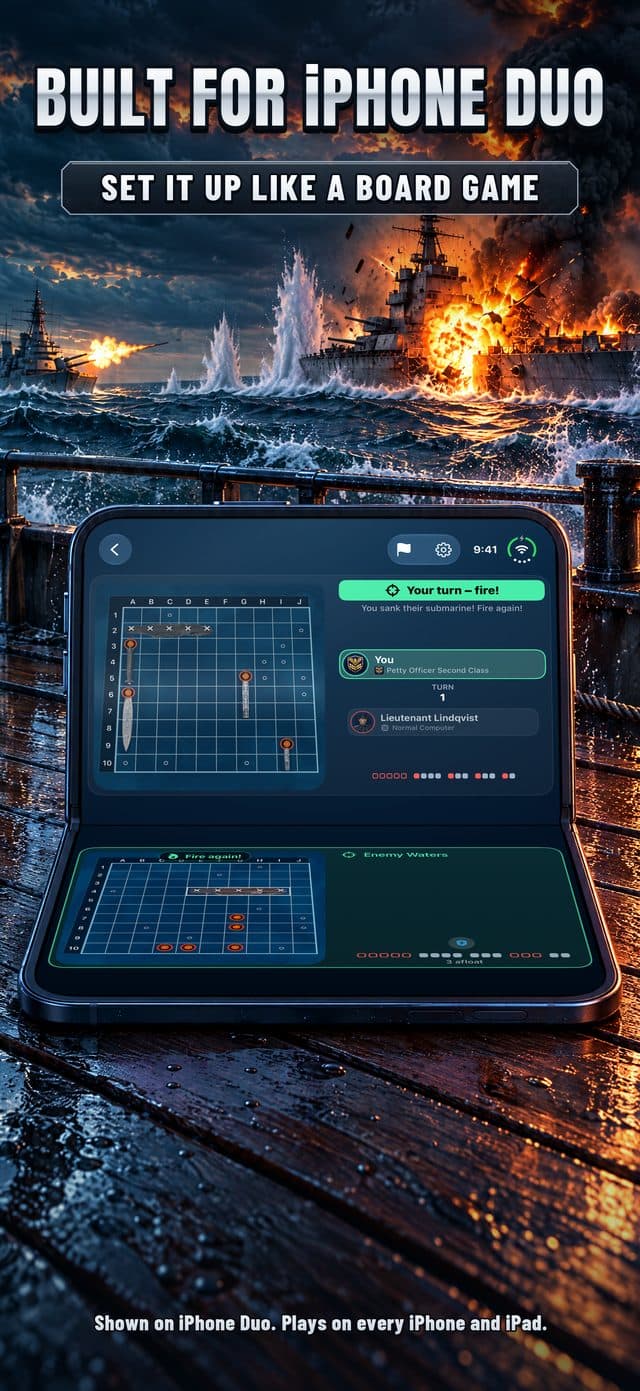
I build Torpedo, an independent sea battle game for iPhone, iPad and iPhone Duo. It isn't affiliated with Hasbro. You choose the 5-ship or the 10-ship fleet and whether ships may touch, so both traditions in this article fit on one board. On the folding iPhone Duo, book mode puts each board on its own half of the screen. The iPhone Duo page shows how that works, and the about page explains who we are.
Questions people ask
When was Battleship invented?
There is no invention date. The sea battle game was a pencil-and-paper folk game first, and a Russian diary mentions playing "sea battle" in 1907. The first known commercial edition was Salvo in 1931, and Milton Bradley's plastic Battleship board game came out in 1967.
Who invented the game Battleship?
No inventor is documented. The story that a man named Clifford Von Wickler invented it around 1900 has no primary evidence behind it. Milton Bradley did not invent the game either; it published a paper version in 1943 and the plastic board game in 1967.
What was Battleship originally called?
It had no single original name. A 1907 Russian diary calls it "морской бой" (sea battle), the first known commercial edition in 1931 was called Salvo, and Milton Bradley's first version in 1943 was Broadsides: The Game of Naval Strategy.
When did Electronic Battleship come out?
Milton Bradley released Electronic Battleship in 1977, and The Strong museum holds a 1977 copy. Electronic Talking Battleship followed in 1989 and added speech, solo play against the computer and salvo rules.
How many ships were in the original Battleship board game?
The 1967 plastic edition used five ships of 5, 4, 3, 3 and 2 squares, 17 squares in all, and that fleet has not changed size since. Older paper versions varied, and the paper game in Russia and Poland uses ten ships covering 20 squares.
Is Battleship in the National Toy Hall of Fame?
Yes. The Strong National Museum of Play inducted it on November 6, 2025, together with Slime and Trivial Pursuit.
The next chapter is yours

Sources
- Battleship (National Toy Hall of Fame inductee page), The Strong National Museum of Play, toyhalloffame.org
- It's a Hit! Battleship Cruises into the National Toy Hall of Fame, The Strong National Museum of Play, museumofplay.org
- 2025 Toy Hall of Fame Inductees Revealed, The Strong National Museum of Play, museumofplay.org
- BATTLESHIP trademark, Reg. No. 0860462 (USPTO data), Justia Trademarks, trademarks.justia.com
- Jim Polczynski, Battleship Games, The Big Game Hunter, thebiggamehunter.com
- Ryurik Ivnev, diary entry of 1 December 1907, Prozhito diary corpus, corpus.prozhito.org
- David H. Ahl (ed.), 101 BASIC Computer Games (1975 printing), Digital Equipment Corporation via Internet Archive, archive.org
- David H. Ahl, BASIC Computer Games (1978), Creative Computing via Internet Archive, archive.org
- Battleship rules (1990), Milton Bradley via Internet Archive, web.archive.org
- Battleship rules (2002), Hasbro via Internet Archive, web.archive.org
- Nick Berry, Battleship (December 2011), DataGenetics, datagenetics.com
- Hasbro, Inc. Form 10-K405 (fiscal 2001), U.S. Securities and Exchange Commission, sec.gov
- Electronic Battleship, BoardGameGeek, boardgamegeek.com
- Electronic Talking Battleship, BoardGameGeek, boardgamegeek.com
- Merlijn Sevenster, Battleships as Decision Problem, ICGA Journal 27(3), 2004, mountainvistasoft.com
- Clifford Von Wickler (person wiki page), BoardGameGeek, boardgamegeek.com
- Battleships (1978), MobyGames, mobygames.com
- Battleship (game), Wikipedia, en.wikipedia.org
- Battleship (1993 video game), Wikipedia, en.wikipedia.org
- Battleship (puzzle), Wikipedia, en.wikipedia.org
- Hermance Edan, Wikipedia, en.wikipedia.org
- FR475243A, Jeu de bataille navale, Google Patents, patents.google.com
- Compucolor, Wikipedia, en.wikipedia.org
- Where the Battleship board game originated, Military Times, militarytimes.com
- Морской бой (игра), Wikipedia (Russian), ru.wikipedia.org
- Okręty, Wikipedia (Polish), pl.wikipedia.org
- Schiffe versenken, Wikipedia (German), de.wikipedia.org
- Bataille navale (jeu), Wikipédia (French), fr.wikipedia.org
- Batalla naval (juego), Wikipedia (Spanish), es.wikipedia.org
- Battaglia navale (gioco), Wikipedia (Italian), it.wikipedia.org
- Zeeslag (spel), Wikipedia (Dutch), nl.wikipedia.org
- Torpedó (játék), Wikipédia (Hungarian), hu.wikipedia.org
- Lodě, Wikipedie (Czech), cs.wikipedia.org
- Amiral battı (oyun), Vikipedi (Turkish), tr.wikipedia.org
- Batalha naval (jogo), Wikipédia (Portuguese), pt.wikipedia.org
- Sänka skepp, Wikipedia (Swedish), sv.wikipedia.org
- Laivanupotus, Wikipedia (Finnish), fi.wikipedia.org
- Papír-ceruza játékok, Játéktan (archived), web.archive.org
Battleship is a trademark of Hasbro. Torpedo is an independent game and is not affiliated with or endorsed by Hasbro.
