Quick answer
Battleship is a two-player guessing game. Each player hides five ships (Carrier 5, Battleship 4, Cruiser 3, Submarine 3, Destroyer 2, so 17 squares) on a 10×10 grid. You take turns calling squares like B7, the defender answers hit or miss and announces each sunk ship, and whoever sinks the whole enemy fleet first wins.
To play Battleship, each player secretly places five ships on a 10×10 grid, then you take turns calling out squares such as "B7." Your opponent answers "hit" or "miss" and tells you when a ship has been sunk. The first player to sink all 17 squares of the other fleet wins.
Those are the core rules. The arguments start over the details: ship sizes, whether ships may touch, whether a hit earns another shot, and which fleet you grew up with. Each of those is answered below.
What do you need to play Battleship?
Each player needs two 10×10 grids. Columns are lettered A to J and rows are numbered 1 to 10, so every square has a name like A1 or J10.
- Your ocean grid (the lower board in the boxed game) holds your own ships and the shots your opponent fires at them.
- Your target grid (the upper board) is where you record your own shots: which squares hit and which missed.
The boxed game uses plastic pegs, red for a hit and white for a miss. On paper, an X for a hit and a dot for a miss do the same job. If you don't own the box, our guide to playing Battleship on paper has a free printable grid with both boards on one sheet.
You also need something that hides your ocean grid. In the boxed game, the upright target board doubles as a screen; on paper, a book or a folder works.
Battleship pieces: the five ships and their sizes
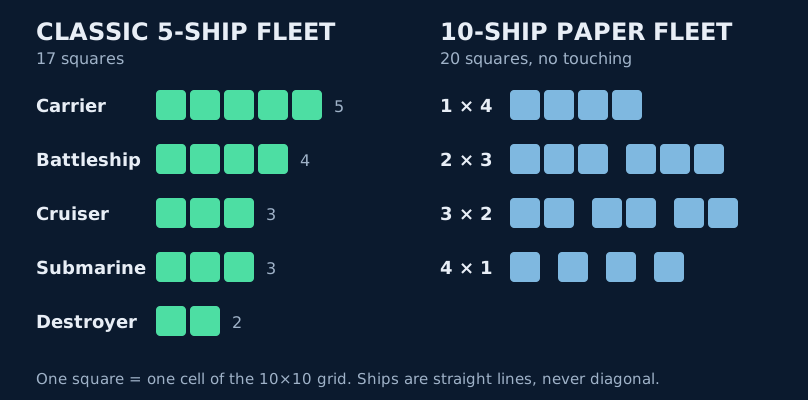
The classic fleet has five ships, and each one is a straight line of squares. The names changed in the 2002 Hasbro edition, but the sizes did not (Wikipedia).
| Ship | Squares | Name in 2002 edition |
|---|---|---|
| Carrier | 5 | Carrier |
| Battleship | 4 | Battleship |
| Cruiser | 3 | Destroyer |
| Submarine | 3 | Submarine |
| Destroyer | 2 | Patrol Boat |
| Total | 17 |
So there are five ships in Battleship for each player, and they cover 17 of the 100 squares. That ratio matters: a random shot hits only 17% of the time at the start, which is why good players stop shooting at random as soon as they score a hit. Our strategy guide and the probability breakdown explain what to do instead.
How do you set up the board?
Before the first shot, both players place their whole fleet on their ocean grid without letting the other see. The placement rules are short:
- Every ship goes in a straight line, either horizontally or vertically.
- No diagonal ships and no bent or L-shaped ships.
- Ships may not overlap, and every square must be on the grid.
- Once the first shot is fired, ships stay where they are for the rest of the game.
Whether ships may touch each other side to side is not settled by the classic rules, which only ban overlaps and diagonals, so many players allow it. The paper traditions of Germany, Poland and Russia forbid it (more on that below). Decide before anyone places a ship.
The next board shows two placements that break the rules. The highlighted squares G2, H3 and I4 are someone's attempt to lay a Cruiser diagonally, which isn't allowed. The two gray ships cross at D6, and two ships can never share a square.
How do you play Battleship? Step by step
- Pick who goes first. Flip a coin, or let the loser of the last game start.
- Call a shot. Name one square on your opponent's grid, letter first and then number: "C7."
- Get the answer. Your opponent checks their ocean grid and says "miss" if the square is empty or "hit" if a ship is there.
- Mark it. You mark the result on your target grid. Your opponent marks a hit on the ship it struck, so both of you know how damaged each ship is.
- Announce a sinking. When every square of a ship has been hit, its owner says so and names the ship: "You sank my Cruiser."
- Pass the turn. In the classic rules each player fires one shot per turn, hit or miss.
- Win. The first player to sink all five enemy ships wins the game.
How do you call a shot?
Say the column letter and then the row number: "B7," "J10," "A1." B, D, E and G sound alike across a table, so some players say "B as in boat." Write each call on your target grid before you hear the answer, so you can't lose track of a square.
What do you say after each shot?
| Result | What the defender says | How the shooter marks it |
|---|---|---|
| Empty square | "Miss" | Dot (or white peg) |
| Ship square, ship still afloat | "Hit" | X (or red peg) |
| Last square of a ship | "Hit, you sank my Submarine" | X, then ring or cross out the whole ship |
The sinking announcement is easy to forget, and it changes the game. Without it, the shooter keeps firing around a ship that is already gone.
How do you win?
You win by hitting every one of the 17 ship squares in the enemy fleet. The fastest possible game takes 17 shots and needs perfect luck. With one shot per turn, no game can run past 100 shots per player, because by then every square has been called.
What are the main Battleship variants?
The classic rules above are only one way to play. These three variants are the ones you will run into most.
Salvo: one shot per surviving ship
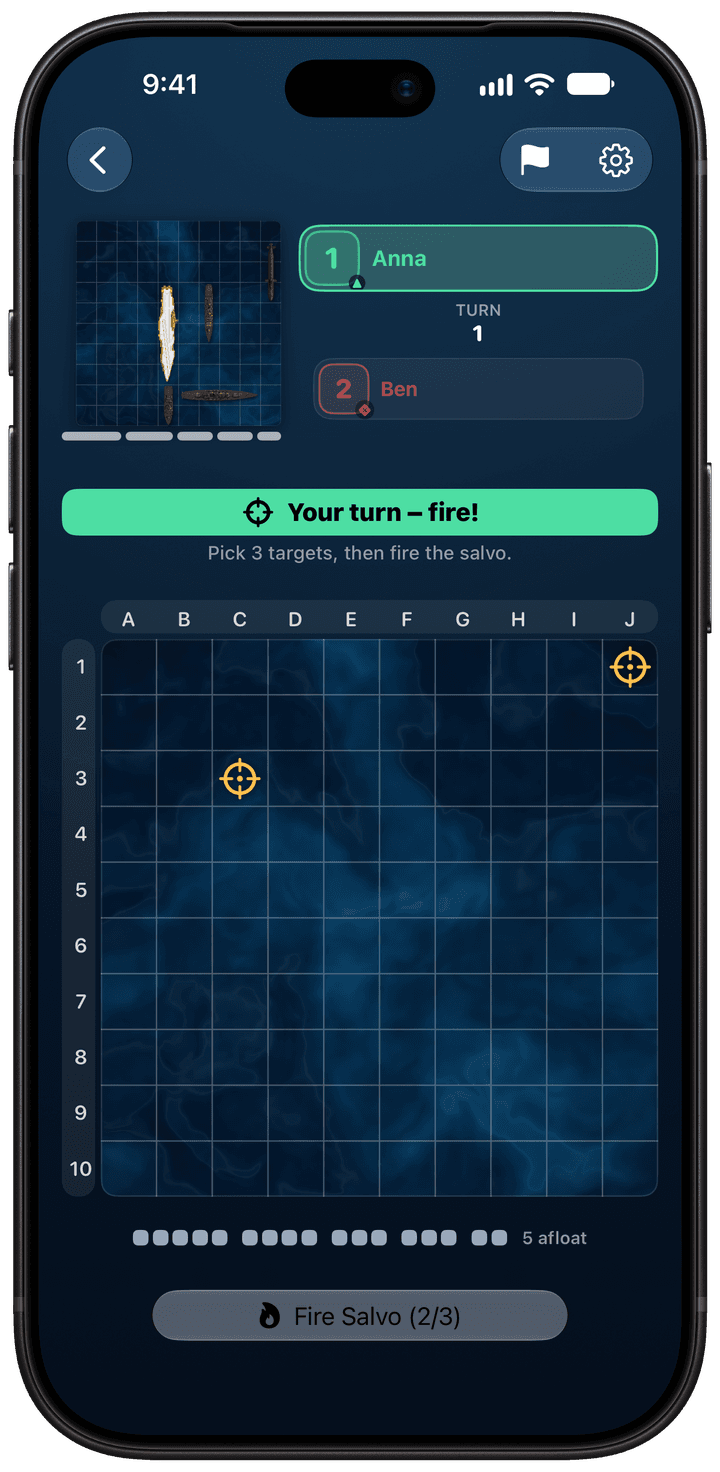
In Salvo, you fire several shots each turn instead of one. The common version gives you one shot for each of your ships still afloat, so five shots at the start. Another version fixes the volley at five shots for the whole game (Wikipedia). The first commercial edition of the game, published by Starex in 1931, was itself called Salvo.
How a Salvo turn works:
- Count your ships still afloat. That is how many squares you call this turn.
- Call all of your squares before hearing any answer.
- Your opponent then reports the volley as a whole: how many hit, and which ships sank.
- Your next volley shrinks every time you lose a ship.
Salvo rewards whoever lands the first sinking, because the other side loses firepower. Some groups report exactly which squares hit; stricter groups only report the number of hits, which turns each volley into a small logic puzzle.
A hit earns another shot
In many countries a hit lets you fire again, and you keep going until you miss. Spanish, Russian, Polish and Hungarian rule write-ups all describe it this way (Spanish Wikipedia, parenting.pl). It makes games faster and swingier: a good hit can turn into a sunk ship in a single turn.
The ten-ship fleet with no touching
Across Russia and much of Eastern Europe, the paper game uses ten small ships instead of five big ones (Russian Wikipedia):
| Ship size | How many | Squares |
|---|---|---|
| 4 squares | 1 | 4 |
| 3 squares | 2 | 6 |
| 2 squares | 3 | 6 |
| 1 square | 4 | 4 |
| Total | 10 ships | 20 |
Ships in this version may not touch, not even at the corners, so every ship sits inside a ring of empty water. That hands the shooter free information: once a ship sinks, you can mark every square around it as empty without firing.
The four single-square ships are the hardest part of the game. They can only be found by luck or by elimination, and they are often the last thing standing.
What is Battleship called in other countries?
The game was played with pencil and paper long before Milton Bradley's 1967 plastic version, and it entered the National Toy Hall of Fame in 2025 (Rochester Business Journal). Every country kept its own name and house rules. Here is how the folk versions differ, based on each language's own rule write-ups.
| Country | Folk name | Usual fleet | Can ships touch? | Hit = extra shot? |
|---|---|---|---|---|
| USA, UK | Battleship, Battleships | 5 ships: 5, 4, 3, 3, 2 (17 squares) | Usually yes | No |
| Germany | Schiffe versenken | 10 ships: 1×5, 2×4, 3×3, 4×2 (30 squares) | No | Varies |
| France | bataille navale | 5 ships: 5, 4, 3, 3, 2 | No | No |
| Spain | hundir la flota | Agreed before play | No, one square gap | Yes, until you miss |
| Russia | Морской бой (Morskoy boy) | 10 ships: 1×4, 2×3, 3×2, 4×1 (20 squares) | No, not even corners | Yes |
| Poland | statki | Built around one 4-square ship | No, not even corners | Yes |
| Hungary | torpedó | Agreed before play, ships of 1 to 5 squares | Agreed; often no | Yes, until you miss |
Sources: German, French (which also lists a ten-ship Belgian fleet), Spanish and Russian Wikipedia, parenting.pl for Poland and Erzsébet-táborok for Hungary. Italians call it battaglia navale, the Dutch Zeeslag and Turks Amiral Battı.
If you play with someone who grew up elsewhere, expect them to assume their own rules. Our history of the sea battle game traces how one pencil game spread into all these versions.
Common Battleship disputes, settled
None of these are covered the same way everywhere, so treat the answers below as sensible house rules. Agree on them before the first shot and the arguments mostly disappear.
Do you have to say which ship was hit?
No. The usual rule is to say "hit" or "miss," and to name the ship only when it sinks (Wikipedia). Naming the ship on every hit is a house rule that makes the game easier. It works well with young kids.
Can ships touch?
In the classic five-ship game, touching is allowed unless your group says otherwise. In the ten-ship game, it is not. Touching ships make the shooter's life harder, because a hit next to a sunk ship could belong to a neighbor.
What if you call the same square twice?
Most players treat it as a wasted shot: the defender says "you already called that" and the turn passes. With young players, let them call again. Writing every call down before hearing the answer prevents it.
What if someone forgot to announce a sinking?
The defender should announce it as soon as they notice. If it only comes out at the end of the game, the fair fix is to replay.
What if someone misreported a hit?
Reveal both boards at the end and check every call. A sensible house rule: if a hit was reported as a miss, the player who made the mistake loses that game. Paper games have no referee, and this end-of-game check is the closest thing to one.
Can you move a ship after the game starts?
No. Placement is fixed once the first shot is fired. On paper, drawing your fleet in pen makes this easy to prove.
How Torpedo handles these rules
I build Torpedo, a sea battle game for iPhone and iPad. The "right" rules depend on where you learned the game, so we made each of the disputed rules a setting instead of a fixed default:
- Fleet: the classic 5-ship fleet or the 10-ship fleet.
- Touching: ships may touch, or must keep apart.
- Shots: a hit earns another shot, or one shot per turn. There are also multi-shot, Chainfire and secret Salvo rounds.
- Fair play: in online and nearby battles, fleets are sealed before the first shot and checked at the end, so nobody can move a ship or misreport a hit.
The full list is on the features page, and the how-to-play page walks through every mode. If you're choosing an app, our sea battle app comparison ranks eight of them, with the rules each one supports.
Questions people ask
How many ships are in Battleship?
The classic game has five ships per player: a Carrier (5 squares), a Battleship (4), a Cruiser (3), a Submarine (3) and a Destroyer (2). That is 17 squares in total. The paper version common in Eastern Europe uses ten ships covering 20 squares.
Do you get another turn if you hit in Battleship?
Not in the classic American rules, where players alternate one shot each. Many European paper traditions, including the Russian, Polish, Spanish and Hungarian ones, let you keep firing until you miss. Agree on it before the first shot.
Can ships touch in Battleship?
The classic five-ship game only forbids overlapping and diagonal placement, so most players allow touching. The ten-ship paper version requires an empty square around every ship, corners included. Settle it before anyone places a ship.
What are the Salvo rules in Battleship?
In Salvo you fire one shot for each of your ships still afloat, so five at the start. You call all of them, then your opponent reports the results of the whole volley. As you lose ships, your volleys get smaller.
Do you have to say which ship was hit?
Under the usual rules you only say hit or miss, and you name a ship when it sinks. Naming the ship on every hit is a house rule that makes the game easier and faster, which can help with young players.
What is the fewest number of shots needed to win Battleship?
Seventeen, one for each ship square in the classic fleet, and only with perfect luck. With one shot per turn and no extra shots, a game can never take more than 100 shots per player.
Your fleet is waiting

Sources
- Battleship (game), Wikipedia, en.wikipedia.org
- Battleship instructions (PDF), Hasbro, hasbro.com
- New class announced for National Toy Hall of Fame, Rochester Business Journal, rbj.net
- Schiffe versenken, Wikipedia (German), de.wikipedia.org
- Bataille navale (jeu), Wikipédia (French), fr.wikipedia.org
- Batalla naval (juego), Wikipedia (Spanish), es.wikipedia.org
- Морской бой (игра), Wikipedia (Russian), ru.wikipedia.org
- Gra w statki. Na czym polega?, parenting.pl, parenting.pl
- Játékajánló: Torpedó, Erzsébet-táborok, erzsebettaborok.hu
Battleship is a trademark of Hasbro. Torpedo is an independent game and is not affiliated with or endorsed by Hasbro.
